The Quiet Accumulation of Scale- Reflecting on a weekend workshop.
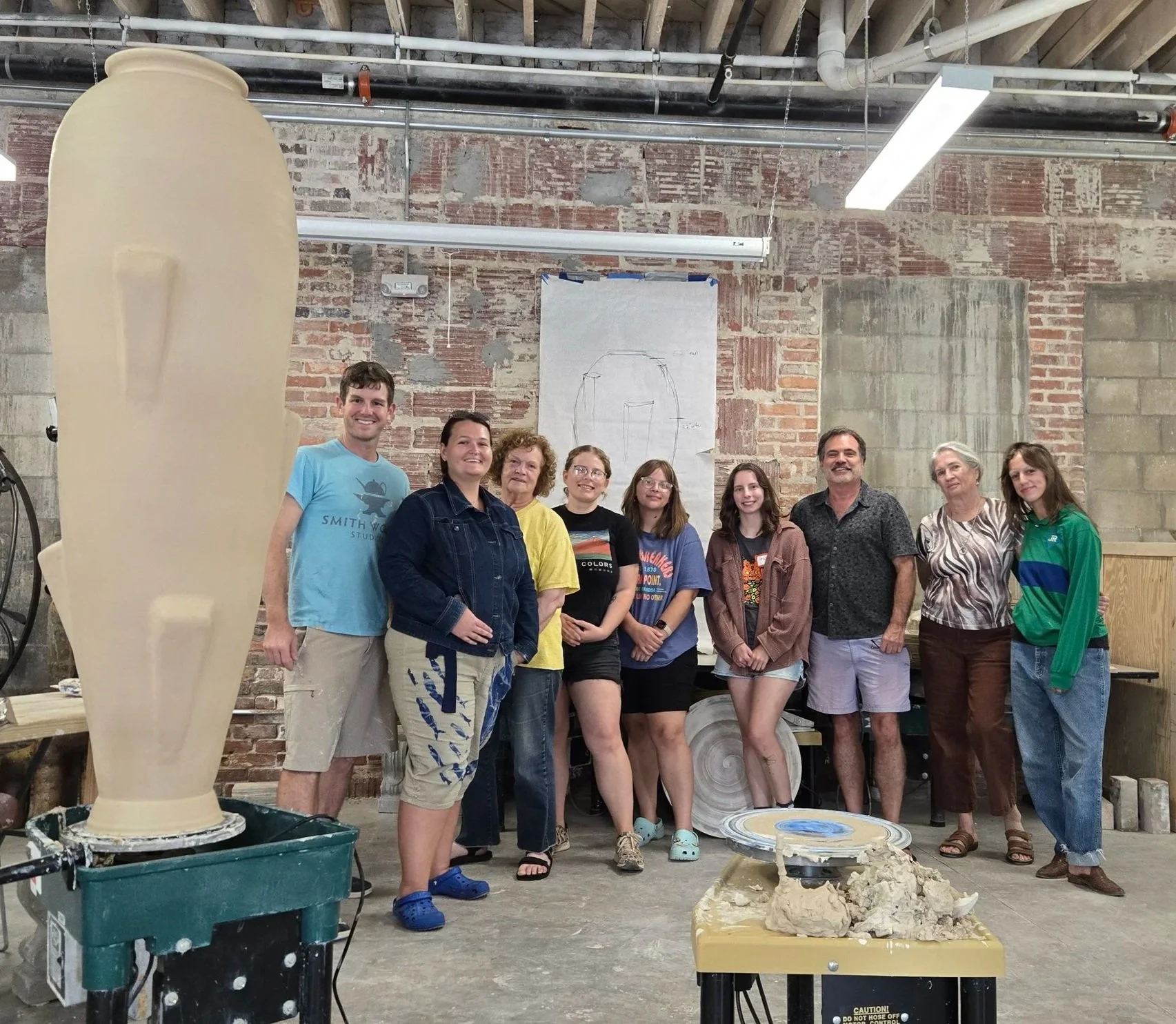
Over the course of a 2-day, weekend workshop at the Morean Workshop Space I created a sixty-three inch tall vessel that weighed a little over 150 pounds. Made from 25 pound sections, those sections were joined, altered, compressed, and extended until they became a single form… essentially slab-building with wheel-thrown slabs. The finished scale is immediately visible, though more difficult to perceive is the time contained within the project.
Large pots are occasionally interpreted as demonstrations of strength because the size is vulnerable to a kind of theater around the making: large quantities of clay paired with strenuous/exaggerated gestures. There is certainly labor involved and clay has weight; that remains true. Also, gravity absolutely remains an active threat throughout the process. However, I have never found “brute strength and ignorance” to be a successful mental framework.
My process is additive and results in scale quickly while individual steps proceed slowly. As one of the participants said: “It’s a fast-slow process”.
A Discussion of Scale
In an interview for Goldmark Gallery, Svend Bayer described his favorite large pot as “very quiet, it doesn’t shout...It’s very strong, it’s not macho, in fact it’s quite feminine”. That sentiment resonates with me because it identifies something easily obscured by the finished object. Bayer did not achieve scale by centering the full weight of the pot at once. He worked incrementally, adding clay over time and allowing repetition, patience, and accumulated judgment to produce the final volume. His process replaced the spectacle of strength with sustained attention.
A large pot is not conquered. It is attended to.
My own method follows a similar cadence in which each section is manageable by itself. I throw one part, establish its direction, and prepare it to receive the next. As the sections are joined, the previous decisions begin to exert pressure on everything that follows. A slight change in diameter can redirect the entire silhouette. A wall left too thick creates unnecessary weight and one made too thin may not support the clay above it. Each addition requires me to read what is already present rather than merely impose some imagined ideal and the whole is absolutely more than the sum of its parts.
The physical scale grows, but the actual tasks remain intimate: a seam compressed between two fingers, a curve gently adjusted by the edge of a rib, a slight pause while the clay becomes firm enough to continue.
This process is meditative. The same actions return in succession—throwing, waiting, joining, compressing, and perceiving. Progress is measurable, but it cannot be hurried without consequence. The form-in-progress asks for attention to the present section while requiring awareness of a realized form that does not yet fully exist.
Bayer’s reflections on large pottery helped articulate this distinction for me: scale need not be loud. It can emerge through quiet, repetitive labor. The strength involved is less about a single moment of exertion than the discipline to remain responsive over time. His fuller discussion of life, throwing, glazing, and firing can be seen in the Goldmark film, Svend Bayer: Potter.
Looking Toward Toshiko Takaezu
The creative point of departure for this first piece in this new body of work was the work of Toshiko Takaezu.
Takaezu progressively moved beyond the functional vessel to develop the closed forms for which she is best known. Made through traditional pottery processes, these works operate as sculpture; volumes in which the interior remains present but largely inaccessible. Some were intimate enough to hold; others approached six feet and required scaffolding during construction. Regardless of the difference in scale, the forms retained a combination of fullness, restraint, and un-ignorable presence.
I was not interested in reproducing a particular Takaezu form. I was looking instead at the authority of her silhouettes: the way volume could be expansive and the way a relatively quiet exterior could hold sustained attention.
My piece remains open at the top and retains the language of a vessel more explicitly than many of Takaezu’s closed forms. It also carries interruptions to its otherwise continuous profile. These projecting elements complicate the outline and interrupt an easy reading of the pot as a single symmetrical volume. Even so, the elongated body and the gathering of the shoulder communicate form that might possess presence without relying on excess. Maybe one day I will depart from the “vessel” but I am not ready to close the top just yet.
Takaezu’s practice also resisted separating art from the rhythms of ordinary life. Her ceramics existed alongside painting, weaving, gardening, teaching, and mentorship. That integration matters to me because a pot is shaped not only by its immediate references, but by the pattern of life that makes its creation possible. More about her work and legacy can be found through the Toshiko Takaezu Foundation.
Making in the Presence of Others
Building this piece during a workshop changed the experience of making it.
In the privacy of the studio, many decisions remain intuitive. I may recognize that a curve needs to move without immediately putting into words why it needs to move. Teaching requires those judgments to be verbalized and I must explain what I am seeing, identify the problem, and justify my solution.
The participants brought sustained attention to that process. Their questions slowed down moments that might otherwise have passed without comment and opened conversations about structure, proportion, drying, joining, and the less measurable act of knowing when not to intervene. They did not simply watch a large pot appear but accompanied me during its uncertainty.
I am grateful to everyone who entrusted me with their time this weekend. A workshop depends upon the willingness of people to show-up, ask honest questions, and share something of their own experience. Thank you to Quinn who reminded me to verbalize my “stream of consciousness”.
I am also grateful to the Morean Workshop Space for the invitation and for providing the equipment, assistance, and physical room required to undertake this project. My history with the Morean reaches back to my first firing in their anagama in 2017 and I could not have imagined I would be here now when I first climbed inside that kiln.
My Support Framework
Arguably the most important support for this project occurred outside of the workshop environment.
While I was away making and teaching, Laura cared for our family. That work does not appear in photographs of the finished pot, but it is inseparable from its existence. Time in the studio is never created from nothing; it is made possible through choices, exchanges, and frequently through the unseen labor of someone else. I am grateful that we met in art school because we both know the importance of studio time.
Laura continues to make room for this work while carrying responsibilities that are every bit as physical, repetitive, and consequential as those taking place in the studio. I am deeply grateful to her; not simply for allowing me to attend a workshop, but for sustaining the life to which I return when the workshop is over.
The building of the form is now complete, though “complete” remains a provisional word in ceramics. For now, the pot stands as evidence of accumulation: section upon section, decision upon decision, and hour upon hour. Its scale did not arrive through a single heroic gesture but grew through quiet discipline.